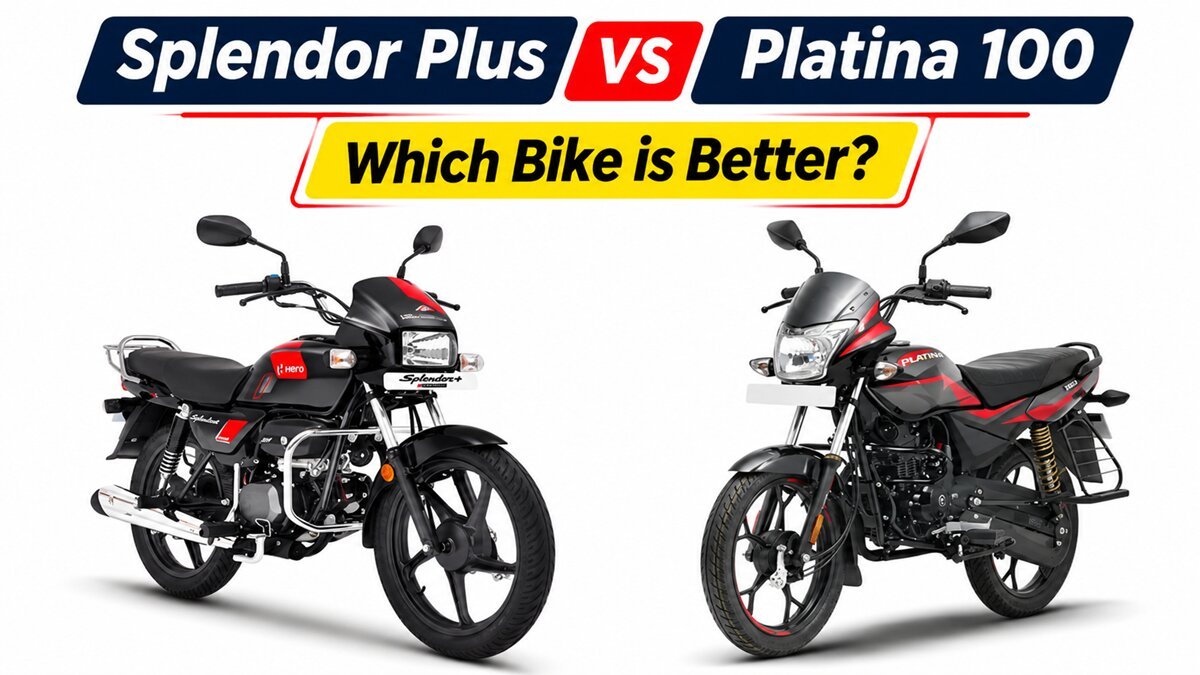
For someone planning to buy a commuter motorcycle without spending too much, Hero Splendor Plus and Bajaj Platina 100 are two options worth considering. Both focus on affordable daily travel, but their approach to comfort, features and pricing is slightly different.
Hero has built its reputation around Splendor’s familiar design and everyday usability, while Bajaj gives Platina 100 a more comfort-focused setup. So, in the Hero Splendor Plus vs Bajaj Platina 100 comparison, which motorcycle makes more sense for everyday use? Let’s look at what each bike offers.
Table of Contents
Hero Splendor Plus vs Bajaj Platina 100 Price
Price is one area where Bajaj has an advantage. According to current listings on ZigWheels, Bajaj Platina 100 starts at Rs. 70,511, while Hero Splendor Plus starts at Rs. 78,912 (ex-showroom). That’s a difference of around Rs. 8,400.
For buyers working with a limited budget, this gap can make Platina 100 an attractive option. However, final on-road prices depend on registration charges, insurance and dealer offers. It is worth checking a local showroom quote before making a decision.
Engine Performance Is There Much Difference?
Both motorcycles use small air-cooled, single-cylinder engines paired with four-speed gearboxes. Hero Splendor Plus gets a 97.2cc engine producing 8.02 PS and 8.05 Nm of torque.
Bajaj Platina 100 uses a slightly larger 99.59cc engine. It produces 8.2 PS at 7,500 rpm and 8.3 Nm at 5,500 rpm.
On paper, Platina has a small advantage in both power and torque. However, these numbers are quite close, and neither motorcycle is designed for aggressive riding. Both are aimed at people who need a dependable bike for regular city journeys.
Mileage Both Motorcycles Claim 70 kmpl
Mileage remains an important reason behind the popularity of 100cc commuter bikes. According to current model listings, both Hero Splendor Plus and Bajaj Platina 100 carry a claimed mileage figure of around 70 kmpl.
However, actual fuel economy can change depending on traffic, riding speed, road conditions and maintenance. A motorcycle ridden regularly in heavy city traffic may return different figures from one used on open roads.
Comfort and Suspension Platina Has a Different Approach
This is where Bajaj Platina 100 makes an interesting case. It gets a long, single-piece seat and Bajaj’s spring-in-spring rear suspension setup, designed to improve ride comfort over uneven roads.
Another advantage is its 200mm ground clearance. This can be useful when riding over speed breakers and rough patches. Its 11-litre fuel tank is also larger than Splendor Plus’s 9.8-litre tank.
Hero Splendor Plus, meanwhile, has a lower seat height of 785mm compared with Platina’s 807mm. It is also lighter, with a listed kerb weight of around 112kg against Platina’s 117kg.
For shorter riders or people who prefer a lighter motorcycle in crowded city traffic, Splendor Plus may feel easier to manage. Riders who regularly travel on rough roads may appreciate Platina’s suspension setup.
Features and Everyday Convenience
Hero Splendor Plus offers features such as i3S idle stop-start technology on applicable variants, alloy wheels and tubeless tyres. Its familiar layout and practical equipment make it suitable for regular commuting.
Bajaj Platina 100 takes a simpler route. It offers electric start, alloy wheels, an LED daytime running light and an analogue instrument cluster. Its focus is more on basic commuting requirements than additional equipment.
One practical difference is tyre type. Splendor Plus comes with tubeless tyres, while Platina 100 uses tube-type tyres in its listed specification. This is worth considering because a puncture can be easier to manage with tubeless tyres.
Which Motorcycle Should You Choose?
Bajaj Platina 100 makes sense for buyers who want a lower purchase price, a larger fuel tank and a suspension setup designed around comfort. Its higher ground clearance is another useful advantage for everyday Indian road conditions.
Hero Splendor Plus is a better fit for riders who prefer a lighter motorcycle, lower seat height and tubeless tyres. Its i3S technology on applicable variants also adds convenience during frequent stops in city traffic.
Both motorcycles have their own strengths, and choosing between them depends on how and where you plan to ride. A test ride of both models, along with a comparison of local on-road prices, will give you a much clearer idea before booking.
Sources: ZigWheels