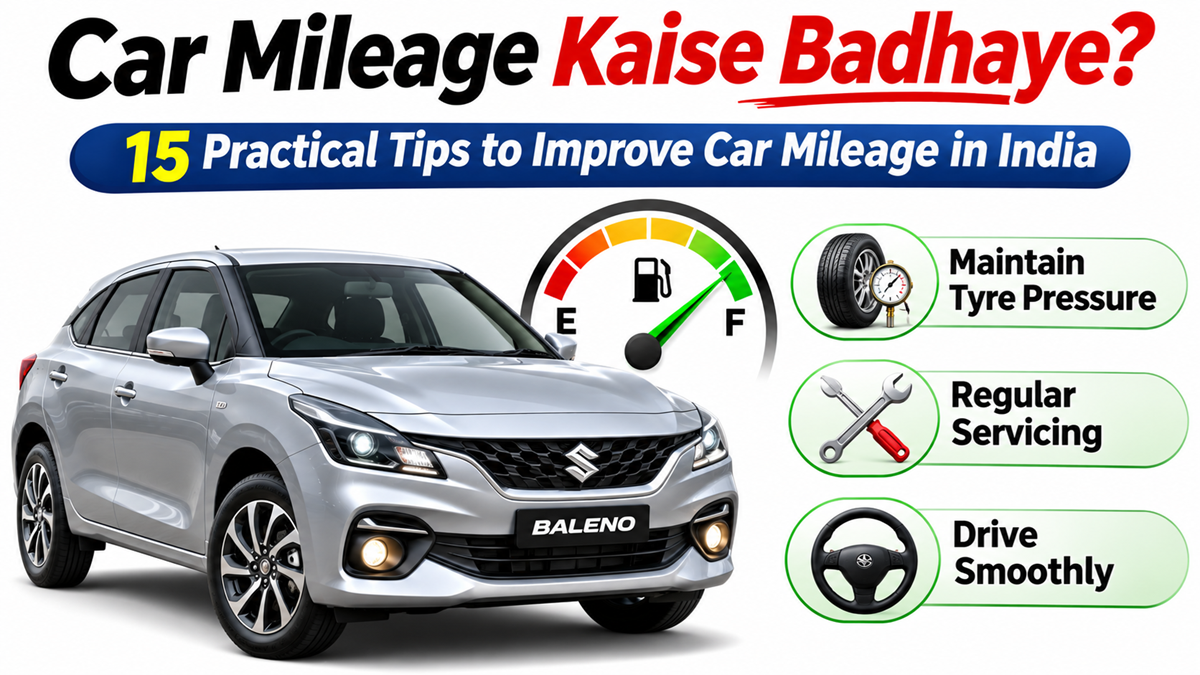
Car Mileage Kaise Badhaye: Fuel costs are a regular concern for car owners in India. Whether you drive a hatchback, sedan or SUV, improving fuel efficiency can help control everyday running expenses. A car’s mileage is not determined by its engine alone. Driving style, tyre pressure, traffic, vehicle load, maintenance and road conditions all influence fuel consumption.
If your car is delivering less mileage than expected, start with simple checks before spending money on additives or aftermarket devices. This guide explains practical steps that can help maintain fuel efficiency, how to measure your car’s actual mileage and when a drop in mileage needs a mechanic’s attention.
Table of Contents
Car Mileage Kaise Badhaye
1. Maintain the recommended tyre pressure
Underinflated tyres create greater rolling resistance, so the engine may need more energy to move the vehicle. Check pressure at least once a month and before long trips, preferably when tyres are cold. Follow the pressure printed on the vehicle’s tyre-information label or in its owner’s manual. Do not overinflate tyres to chase better mileage; incorrect pressure can affect grip, braking and tyre wear.
2. Accelerate smoothly and avoid hard braking
Rapid acceleration followed by sudden braking wastes energy, particularly in stop-and-go traffic. Look ahead, leave a safe gap and build speed gradually. Smooth driving can improve efficiency while also reducing wear on brakes and tyres. Always adapt your speed to traffic, visibility and road conditions.
3. Follow the scheduled service plan
Regular maintenance helps keep an engine and its supporting systems working as intended. Follow the service intervals in your owner’s manual and use parts and fluids that meet manufacturer specifications. Ask the service technician to inspect filters, ignition components, brakes and any warning lights rather than replacing parts without a diagnosis.
4. Inspect the air filter
An air filter keeps dust and debris away from the engine. In dusty conditions it may become dirty sooner, so have it inspected during scheduled maintenance. Replace it when required by the manufacturer. A new air filter is not a guaranteed mileage upgrade for every modern fuel-injected car, but a badly restricted filter should not be ignored.
5. Use the correct engine oil
Choose engine oil with the viscosity grade and performance specification recommended in your owner’s manual. Oil that does not meet the required specification may affect engine protection and operation. Follow the recommended replacement interval and avoid assuming that a more expensive oil will automatically deliver better mileage.
6. Remove unnecessary weight
Extra weight makes a vehicle work harder, especially during repeated acceleration. Clear out heavy items that you do not need for everyday journeys. Roof boxes and carriers can also increase aerodynamic drag, particularly at higher speeds. Keep essential safety equipment in the car, but avoid carrying unused luggage permanently.
7. Use air conditioning sensibly
Running the air conditioner requires energy and can increase fuel use, although its effect varies with vehicle design, outside temperature and driving conditions. Set a comfortable cabin temperature and use recirculation when appropriate. At higher speeds, open windows can add aerodynamic drag, so switching off AC is not always the most efficient choice. Comfort and safe driving should come first.
8. Avoid prolonged idling
An engine running while a car is stationary consumes fuel without covering any distance. If you expect a longer wait and it is safe to do so, switch off the engine. Follow your vehicle’s guidance for start-stop systems and never turn the engine off where doing so could affect control or essential systems.
9. Check wheel alignment when symptoms appear
Incorrect alignment can cause uneven tyre wear and make a car pull to one side. If the steering wheel is off-centre, the vehicle wanders or tyres wear unevenly, ask a qualified workshop to inspect alignment. Wheel balancing should also be checked if you notice vibration at particular speeds.
10. Maintain a steady, legal speed
Fuel consumption often rises at higher speeds because aerodynamic drag increases. Where conditions allow, maintain a steady speed within posted limits and avoid unnecessary speed changes. Cruise control may help on suitable open roads, but do not use it in heavy traffic, poor weather or on roads where constant speed is unsafe.
11. Select the right gear
In a manual car, use a gear that suits road speed and engine load. Driving at high engine RPM for no reason can waste fuel, while selecting a gear that is too high at low speed can make the engine struggle. Follow the owner’s manual and pay attention to engine response. Automatic-transmission drivers should generally allow the transmission to manage shifts in normal driving.
12. Plan journeys and routes
Heavy congestion, repeated stops and long detours can increase fuel use. Check traffic before leaving, combine nearby errands where practical and choose a safe route with fewer delays. Do not take an unfamiliar or unsafe shortcut just to save a small amount of fuel.
13. Watch for dragging brakes
A brake that does not release correctly can create resistance and may increase fuel consumption. Warning signs can include a vehicle pulling to one side, unusual heat near a wheel, a burning smell or abnormal brake wear. Stop safely and have the braking system checked promptly. Brake repairs are safety-critical and should be handled by a qualified technician.
14. Use fuel that meets your vehicle’s requirements
Follow the fuel grade and specification stated by your vehicle manufacturer. Premium petrol does not automatically improve mileage in a car designed for regular fuel. For ethanol-blended petrol such as E20, check your model’s compatibility and manufacturer guidance. Fuel economy can vary with fuel composition and vehicle technology.
15. Measure actual mileage instead of guessing
Dashboard figures are useful for day-to-day reference, but a full-to-full calculation can help you estimate real-world fuel economy. Fill the tank using the same method, reset the trip meter, drive a reasonable distance and refill again. Divide kilometres travelled by litres added. Repeat over several refills for a more dependable average.
How to Calculate Car Mileage: A Simple Example
| Measurement | Example |
|---|---|
| Distance travelled | 450 km |
| Fuel used | 30 litres |
| Calculated mileage | 15 km/l |
In this example, 450 kilometres divided by 30 litres equals 15 km/l. For consistency, refill at the same pump when possible, use the same cut-off method and compare several readings. Traffic, route, weather and load can change results.
Why Has Your Car’s Mileage Suddenly Dropped?
A sudden or sustained drop deserves attention, especially if your driving pattern has not changed. Possible causes include low tyre pressure, a dragging brake, worn spark plugs in a petrol engine, faulty sensors, a restricted filter, incorrect wheel alignment or a fuel-system issue. Heavy traffic, short trips and prolonged idling can also explain a change without a mechanical fault.
Look for other symptoms such as rough running, warning lights, unusual smells, vibration or loss of power. Ask a qualified mechanic to diagnose the cause. Avoid replacing sensors or other parts based only on guesswork.
Does Switching Off the AC Improve Car Mileage?
It can reduce fuel use in some situations because the air-conditioning compressor needs energy. However, the difference depends on the car, temperature, speed and cabin conditions. At higher road speeds, open windows can increase aerodynamic drag. Use AC sensibly and choose a comfortable setting rather than compromising comfort or concentration to chase a mileage figure.
Does Driving Slowly Always Give Better Mileage?
No. Very low speed in an unsuitable gear can make an engine labour, while unnecessarily high speed increases aerodynamic resistance. Aim for smooth acceleration and a steady, legal speed that suits your vehicle and road conditions. There is no single speed that guarantees best mileage for every car.
Frequently Asked Questions
How can I improve car mileage quickly?
Check tyre pressure, remove unnecessary luggage, avoid aggressive acceleration and reduce prolonged idling. If mileage remains unusually low, arrange a vehicle inspection.
Does changing engine oil increase mileage?
Using the correct engine oil and changing it on schedule supports proper lubrication and engine operation. An oil change alone does not guarantee a specific mileage increase.
Does tyre pressure affect fuel consumption?
Yes. Underinflated tyres increase rolling resistance and can increase fuel use. Maintain the pressure recommended by your car manufacturer.
Why is city mileage lower than highway mileage?
City driving often involves congestion, idling and frequent acceleration and braking. Steady highway driving may use less fuel, depending on speed, road conditions and vehicle type.
How often should I check tyre pressure?
Check it at least monthly and before long journeys. Measure when tyres are cold and use the recommended pressure shown in the owner’s manual or vehicle label.
Can premium petrol improve mileage?
Not necessarily. Use the fuel grade specified by your vehicle manufacturer. A higher octane rating does not automatically mean better mileage in an engine that does not require it.
Source: Maruti Suzuki Official