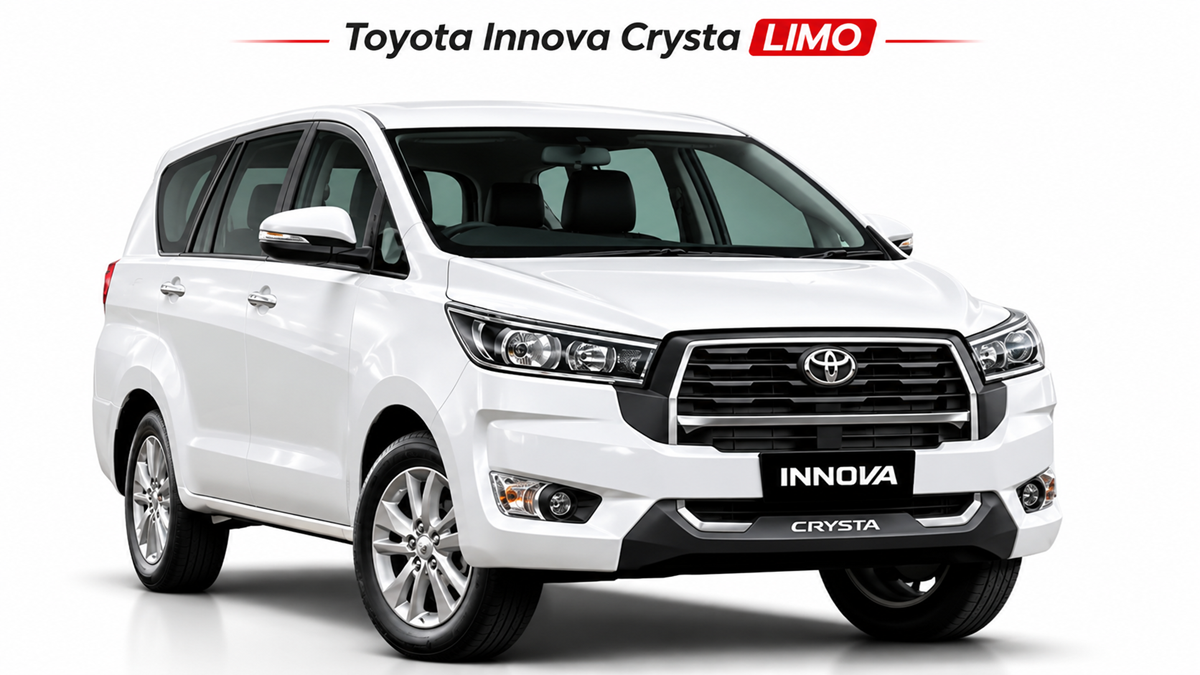
Toyota Kirloskar Motor has introduced the Toyota Innova Crysta LIMO, a dedicated offering for fleet operators and commercial mobility customers in India. Announced on November 5, 2026, the new identity is intended to give the Innova Crysta a clearer position in professional passenger transport, while retaining the established diesel powertrain and cabin-focused approach that have made the MPV popular with operators.
This is not a new-generation Innova or a major mechanical update. Toyota says the LIMO offering is available exclusively in the GX-SLF grade. The company has also confirmed that the prices of its two fleet configurations remain unchanged, with the seven-seat version listed at ₹19.95 lakh and the eight-seat version at ₹19.99 lakh, ex-showroom.
Table of Contents
Toyota Innova Crysta LIMO
LIMO name gives Toyota’s commercial and fleet-focused Innova Crysta range a distinct identity. The company says professional mobility customers have been an important part of the Innova’s journey for more than two decades, and this move is intended to strengthen that connection. The target audience includes businesses that need vehicles for passenger movement rather than private family use alone.
Toyota has not presented the LIMO as a separate platform or a new body style. The offering is based on the existing Innova Crysta and is restricted to the GX-SLF grade. The announcement highlights the familiar strengths of the MPV: a spacious cabin, passenger comfort, reliability and the established Toyota ownership network. Captain seats are specifically mentioned as part of the fleet-focused package.
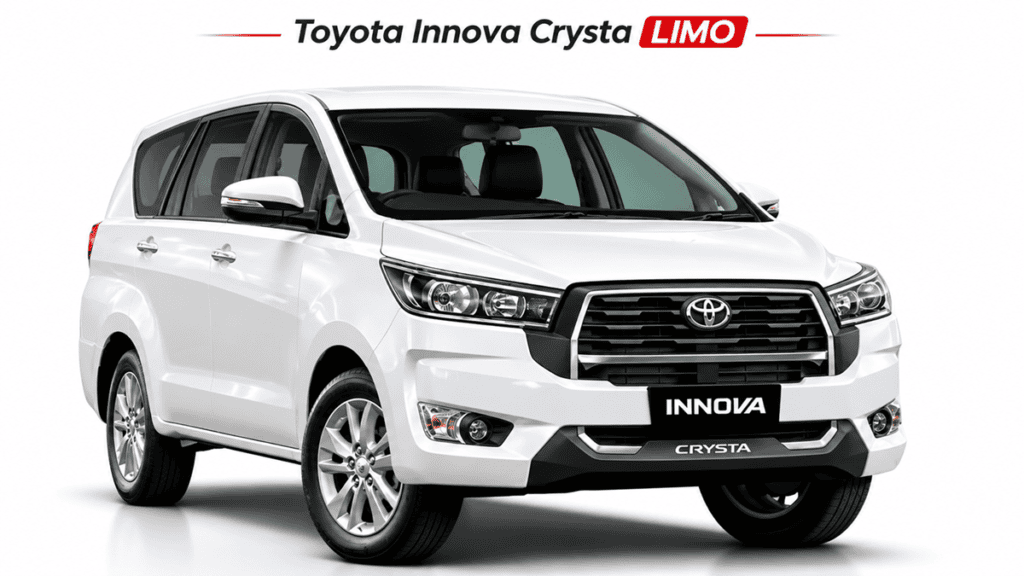
Toyota Innova Crysta LIMO Price and Seating Options
Toyota’s announcement lists two fleet configurations and confirms that their prices have not changed with the introduction of the LIMO identity.
| Fleet configuration | Seating | Ex-showroom price |
|---|---|---|
| Innova Crysta GX Fleet | 7-seater | ₹19.95 lakh |
| Innova Crysta GX Fleet | 8-seater | ₹19.99 lakh |
Difference between the listed prices is ₹4,000. Fleet buyers should still obtain a written quotation from an authorised Toyota dealer, as the final on-road amount will include registration, insurance and any applicable local charges. Operators should also confirm the exact seating layout and grade code on the invoice before placing an order.
LIMO branding does not bring a separately announced price premium. Toyota’s stated position is that the existing fleet prices continue. The broader Innova Crysta range remains available in GX, GX+, VX and ZX grades, while the LIMO identity is specifically aimed at the commercial customer base.
2.4-Litre Diesel Engine and Manual Gearbox Continue
Toyota Innova Crysta LIMO retains the familiar 2.4-litre diesel engine. Toyota’s official specification sheet for the Crysta lists an output of 150 PS and 343 Nm of torque, paired with a five-speed manual transmission. The rear-wheel-drive layout and the engine’s strong low-speed response are suited to a vehicle expected to spend long hours carrying passengers.
Toyota quotes fuel efficiency of up to 15 km/l for the Innova Crysta. This is the manufacturer’s stated figure for the model range, not a guaranteed result for every LIMO vehicle or operating route. Actual fuel consumption will depend on passenger load, traffic, road conditions, air-conditioning use, maintenance and driving style. The company has not announced a separate fuel-economy figure specifically for the LIMO identity.
No new engine, automatic gearbox or additional performance specification has been announced for this offering. Buyers should therefore view it as a fleet-focused version of the existing Crysta rather than a mechanical upgrade.
Cabin Comfort and Practical Features
Passenger comfort is central to the LIMO positioning. Toyota highlights captain seats, a spacious cabin and the Crysta’s established ride comfort. The MPV also offers air-conditioning for all rows, along with generous headroom and legroom. These details matter for hotel transfers, corporate transport and longer intercity journeys, where passengers may spend considerable time in the vehicle.
Standard Crysta equipment list includes a touchscreen infotainment system with smartphone connectivity and steering-mounted controls. Feature availability can differ by grade, so fleet customers should check the exact GX-SLF equipment list with Toyota rather than assume that every feature offered on higher Crysta grades is included in the LIMO.
Safety Equipment and Ownership Support
Toyota lists safety equipment such as seven airbags, anti-lock braking with electronic brake-force distribution and brake assist, Vehicle Stability Control and Hill Start Assist Control on the Innova Crysta range. The precise equipment on the selected fleet grade should be confirmed before purchase, particularly when a business is buying several vehicles for professional use.
Company offers a standard warranty of three years or 1,00,000 km, whichever comes first. Toyota says customers can extend the coverage up to five years or 2,20,000 km. Its ownership support also includes finance schemes of up to seven years, Express Maintenance Service and 24×7 roadside assistance. These provisions may be relevant to operators planning vehicle utilisation over several years, although finance approval and terms will depend on the customer and lender.
What the LIMO Identity Means for Fleet Operators
For fleet businesses, the main change is clearer product positioning rather than a new technical package. A dedicated identity can make it easier for Toyota to address commercial buyers, while the existing Crysta hardware keeps the proposition familiar. Businesses considering the MPV should compare the total cost of ownership, not just the ex-showroom price. Fuel use, scheduled servicing, insurance, permits, driver costs, downtime and resale value all affect the economics of a working vehicle.
Seven-seat and eight-seat layouts also serve different operating needs. A seven-seat configuration may suit services where individual passenger comfort is a priority, while an eight-seat layout can be useful when carrying more occupants is important. The best choice will depend on the operator’s route, customer profile and luggage requirements.